

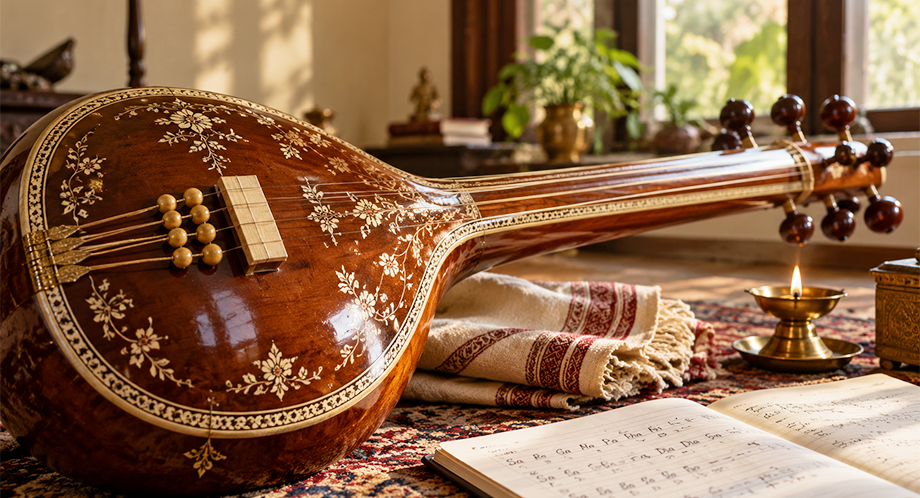
In Indian classical music, the Tanpura has a very special place. It may not carry the melody itself, but its continuous, resonant sound creates the musical space in which a vocalist finds and understands the Sur.
When I teach my students, I often encourage them to listen carefully to the Tanpura. That constant drone helps us establish our ‘Sa’ and develop a stronger sense of pitch. Over time, it becomes almost like a musical companion, quietly present, yet deeply important.
A Tanpura is made up of several important parts, each contributing to its sound and function.
The ‘Tumba’, or ‘resonator’, is the large hollow body that amplifies the sound. The long ‘Dand’, or ‘fingerboard’, forms the main structure of the instrument, while the ‘strings’ (Taar) produce the continuous drone that we hear.
At the top, the ‘Peg Box’ (Headstock) holds the tuning pegs, while the ‘Khunti’ helps tune each string to the desired pitch. The Aad’ or ‘Meru’, along with the bridge, supports the strings and contributes to the Tanpura’s distinctive resonance.
The ‘Manaka’, or ‘fine tuner’, allows for more precise tuning, while the ‘Langot’ holds the strings securely at the lower end. Decorative elements such as the ‘Patta’ may add to the traditional beauty of the instrument.
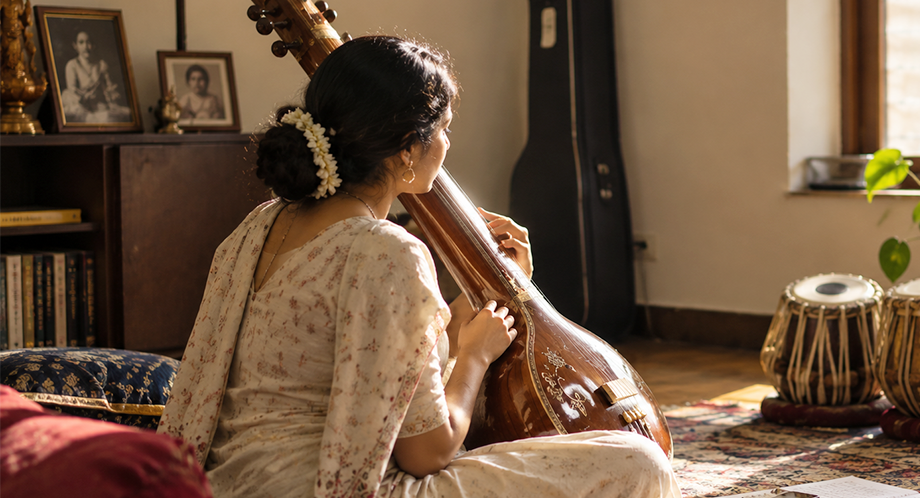
But beyond its physical structure, what makes the Tanpura truly special is what it teaches us as musicians.
It teaches us to listen before we sing.
When the Tanpura is perfectly tuned and the Sa resonates, we begin to understand where our voice belongs within that musical space. With regular riyaaz, this relationship between the voice and the Tanpura becomes more natural and instinctive.
For me, the Tanpura represents something very beautiful about Indian classical music: sometimes, the most important musical presence is the one that does not seek the spotlight.
It simply continues to resonate and in that resonance, the singer finds Sur, stability and the beginning of music.